

Legacy systems often get a bad reputation. They’re labeled as outdated, rigid, and difficult to maintain. But in reality, many of these systems are still the backbone of critical business operations. They hold years – sometimes decades – of business logic, data, and processes that organizations rely on every day.
The real challenge isn’t that legacy systems exist. It’s how we choose to modernize them.
The Myth of “Rip and Replace”
When organizations think about modernization, the first instinct is often a complete overhaul – replace everything with something new. On paper, it sounds clean and future-ready. In practice, it’s expensive, time-consuming, and risky.
Full system replacements can disrupt operations, introduce unforeseen issues, and demand significant retraining. More importantly, they often solve problems that don’t actually exist, while overlooking the ones that matter most.
At Reinvent, we take a different approach.
Start with What’s Actually Not Working
Most legacy systems don’t completely fail. They just… struggle in certain areas.
Maybe reporting takes forever.
Maybe getting data out is harder than it should be.
Maybe business teams depend on developers for even small changes.
These are the things that slow teams down.
So instead of asking, “What do we replace?”
We ask, “What’s causing friction?”
That shift changes everything.
Where Small Changes Make a Big Difference
One of the most overlooked opportunities in legacy environments is the reporting layer.
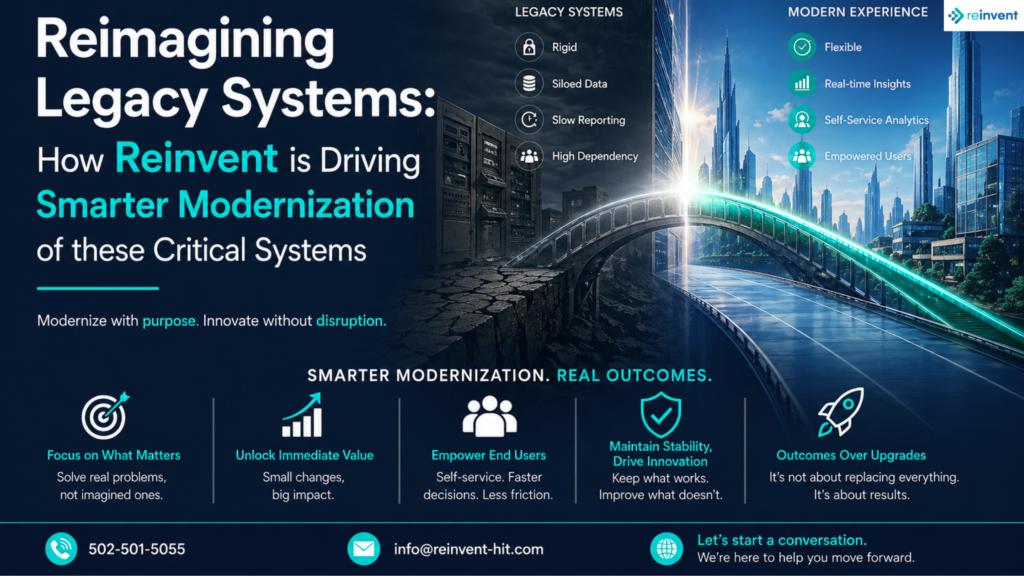
In many cases, business users depend on outdated reporting tools or manual processes to extract insights. By modernizing just this layer – introducing intuitive dashboards, real-time data access, and better visualization – organizations can unlock immediate value.
The core system remains untouched, ensuring stability. But the way people interact with data becomes faster, smarter, and more user-friendly.
A Real-World Example
We worked with a client who had a solid legacy system running their operations. No major issues there.
But reporting? That was a different story.
Every time someone needed insights, it turned into a request. Developers had to step in. Turnaround time was slow. Frustration was high.
Instead of proposing a full rebuild, we focused just on that problem.
We introduced a modern reporting layer that connected directly to their existing system. Nothing disruptive. No overhaul.
What changed?
Business users could access real-time data on their own.
They could build reports without relying on developers.
Decisions started happening faster.
Same core system. Completely different experience.
Empowering the End User
A key part of smarter modernization is shifting control closer to the business.
When end users can access, analyze, and act on data independently, it reduces bottlenecks and increases agility. This doesn’t just improve productivity – it changes how organizations operate.
Modern tools and interfaces play a big role here, but the real value comes from designing systems around user needs, not just technical capabilities.
Small Changes, Big Results
Modernization doesn’t have to be a massive transformation to be meaningful.
In fact, some of the most impactful changes are small and targeted:
- Optimizing a slow process
- Improving data accessibility
- Enhancing user interfaces
- Automating repetitive tasks
These changes add up quickly, driving significant improvements in efficiency and user satisfaction.
Stability Meets Innovation
One of the biggest advantages of a focused approach is balance.
By maintaining the core legacy system, organizations preserve stability and continuity. At the same time, targeted modernization introduces innovation where it matters most.
It’s not about choosing between old and new – it’s about making them work together.
Outcomes Over Upgrades
At Reinvent, we believe successful transformation isn’t defined by how much technology you replace. It’s defined by the outcomes you achieve.
- Are teams working more efficiently?
- Are decisions being made faster?
- Is the system easier to use and maintain?
If the answer is yes, then modernization is working – regardless of how much of the original system remains.
Rethinking the Approach
Legacy systems aren’t going away anytime soon – and they don’t need to.
With the right strategy, they can evolve to meet modern demands without the cost and risk of starting from scratch.
Smarter modernization is about being intentional, focused, and outcome-driven. It’s about solving real problems, empowering users, and delivering value – step by step.
That’s how we approach it at Reinvent.
Conclusion
This is just one example of how Reinvent looks at modernization in the real world. It’s rarely about big, flashy transformations. More often, it’s about stepping in, understanding what’s slowing teams down, and fixing that – without disturbing everything else that’s already working.
Sometimes that means plugging in something like Klarify AI™ so teams can find answers instantly. Sometimes it’s automating workflows with Maruthi AI™, or quickly building what’s missing using SaaS Studio™. And in other cases, it’s as simple as making training effortless with Klarify LMS™. Small additions – but they change how people actually get work done.
And of course, tools alone don’t solve problems. That’s where the team comes in – building, modernizing, strengthening systems, or even just extending your team when you need it. Whatever it takes to move things forward, without unnecessary complexity.
Because in the end, modernization isn’t about starting over.
It’s about making what you already have work better – for the people who rely on it every day.
Our experts are just a conversation away:
 Call us at 502-501-5055
 Email: info@reinvent-hit.com
 Or simply fill out our contact form here and our experts will connect with you to explore the right solution for your needs.